
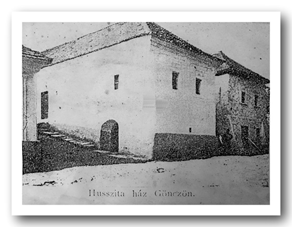
The Gönci Hussite Houses 1936. Image source: Hussite House Collection
Archaeological excavations carried out by the Herman Ottó Museum in the second half of the 1970s, with the involvement of archaeologists from Prague, established that the foundations of the building were laid after the Hussite period. On these foundations, a new house was constructed in the 17th–18th centuries.
Some researchers date the earliest presumed construction of the house to the period following the 15th century. At that time, the region was a significant wine-growing area, and from the 16th century onward the wine trade route leading to Krakow passed through it—along the Hejce Stream and the Hernád River—as confirmed by customs registers, tax records, and cellar books. It can reasonably be assumed that the building already served as the residence of a wine-merchant dynasty, or perhaps functioned as a more substantial structure, such as a large, stable cellar or storage and warehouse building.
The house is one of the former small-windowed, fortress-like stone buildings of Gönc. However, due to the lack of historical sources, the identity of its builder, the history of its construction, and the circumstances surrounding it remain unknown.
The financial background of this large-scale construction was most likely provided by the commercial profits of wines from north-eastern Hungary. The solid and defensive character of the house was primarily justified by the need to protect the busy military and trade route passing through the settlement. Later written sources indicate that many people travelled along the main route of the “good wines of the foothills,” including merchants, soldiers, hunters, and even robbers, who were described as being “thirsty from one place to the next.” Under such circumstances, caution on the part of the inhabitants could only have been beneficial.
Scientific research confirms that the defensive system of the fortress-like stone houses found in the region was based on a strictly observed neighborhood bond (Nachbarschaft), which functioned effectively when residents mutually supported one another. As the Hussite House is a multi-storey building, it was difficult to attack. With its street-facing front wall set forward from the street line (gestaffelt), the former inhabitants could, in an emergency, easily monitor and defend the gate of the neighboring house with arrows or firearms through the side window. As a result, any enemy or marauder advancing into the interior of the settlement was forced to besiege each house one by one.
According to a view maintained to this day, this method of defense is primarily characteristic of German settlers and played a decisive role among the Transylvanian Saxons for a long period. On this basis, some assumptions suggest that the construction of the Hussite House may be traced back to German-Saxon—more precisely, Siebenbürger Sachsen—origins, rather than to the architectural traditions of the Hussites who occupied the Highlands.
It can reasonably be assumed that the military mercenaries who served in the Gönc region for several decades were unlikely to have engaged in such construction work due to lack of time. As additional historical information, it is known that the settlement of Gönc was still referred to as Künzelsdorf in 1469.
It is a documented fact that the predecessors of the folk house—damaged by a series of fires affecting the entire settlement—were renovated in 1832. This renovation involved the reconstruction of both the street-facing section and the rear building, at which time the house was already owned by the Szotáczky family.
The building retained its residential function, while preserving its stylistic features, until the mid-1970s. At that time, the Gönc Village Council—through the initiative of council president Béla Menyhért—purchased it from its then owners, the Gönczi family. During restoration works, it was established that the oldest part of the Hussite House is the vaulted cellar level, which at one time was excellently suited for grape pressing, with an external outlet. In this form, the folk house closely resembles a wine-production house with an elevated residential level.
Based on plans prepared by experts of the National Inspectorate for Monument Protection—Péter Wirth and Béla Sisa—the building acquired its present form during renovations carried out between 1975 and 1978. For more than forty years, it has operated as a country house museum under the name Hussite House, with its exhibition created by the Herman Ottó Museum in Miskolc. During this period, a peasant-bourgeois interior was developed, reflecting the conditions of the former residential building in the second half of the 19th century and presenting the living standards of a relatively affluent family engaged in the wine trade.
Views: 7