
Drinking culture
Since the High Middle Ages, the inhabitants of Gönc have produced high-quality wine from the vineyards of the surrounding hills. The barrel needs of the Tokaj-Hegyalja wine trade were covered by the famous Gönc Barrel.
Similar to many other wine-producing regions, the phylloxera plague reached the Gönc area in the 1890s and caused great destruction. After that, the drinking culture changed significantly; in addition to wine from leftover and replanted grapes, the production of pálinka and the planting of fruit tree plantations came to the fore.
Waste water production
A new drink appeared in Gönc in the early 1890s, soda water. The abundant yield of the surrounding springs was an advantage during production. The sale could have taken place directly from the factory, with the involvement of general stores or even by cart.
Göncön, Zsigmond Reismann and his successors were engaged in soda production, transporting their product by cart and sled. A characteristic of the soda industry was the exchange of the siphon, which was the property of the manufacturer, a fact that was indicated on the soda bottles.
Exhibited objects
▪ Soda siphon, first half of the 20th century – Empty siphons could be exchanged for full ones in exchange for glass, as their inscriptions also indicated.
▪ Wine bottle, early 20th century – During the 19th century, the use of glass became increasingly widespread, thus replacing pottery vessels.
▪ Tobacco cutting machine, 19th century – The tobacco could be cut in portions by compacting it with the device.
▪ Selmec ceramic pipe heads, early 19th century – Pipe production was boosted by the lifting of smoking bans during the reign of Joseph II.
▪ Beer bottle, early 20th century – Beer consumption came to the fore as wine production declined following the phylloxera epidemic. Moskovitz and his son created the Gönczi beer brand in the early 1900s.
▪ Bottle of distilled spirits, early 20th century – Some stores began selling new consumer goods – distilled spirits – which led to a differentiation in drinking culture.
Cooper industry
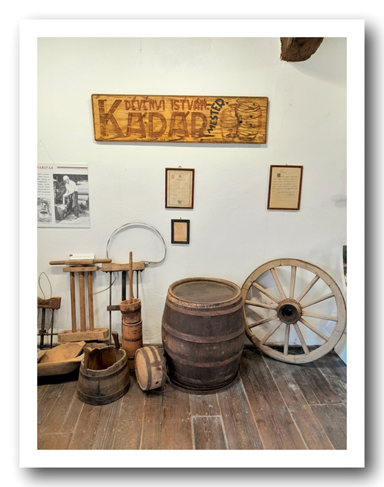
Gönc’s most famous industrial product is the barrel, which became famous far and wide. The surrounding forests provided abundant raw materials for the kádár – barrel maker, the bognár – wheel and cart maker, and the pintér – maker of small household wooden utensils.
The raw material for making barrels was oak, but it could also be sweet chestnut, mulberry and acacia. In the case of making beer barrels, oak, tan and acacia wood were also considered. Smaller vessels could be made of elm, linden and ash.
The staves were made from staves produced from healthy trees cut in winter, split into a mirror or half mirror in the direction of the tree’s longitudinal axis without cutting the fibers. The staves were dried outdoors for a year, after which they became usable for the production of barrels, puttonyok, vats, damage relief, wine funnels, wine buckets, well buckets, tubs, dippers, water cups, and pitchers.
In Gönc, the cooperage industry ended with the careers of masters István Dévényi and Ferenc Takács.
Gingerbread and candle making
In our country, the first gingerbread-making guilds were established at the beginning of the 17th century under German influence. The raw material, ham honey, was purchased from beekeepers by the masters and transported to the workshop in a kopű – a cylindrical wooden container.
After the bees were smoked and the honey and ham were separated, honey dough, lédig dough or sugar dough was made. The first documented gingerbread maker in Gönc was István Fojthó, whose son Gyula Fojthó worked as a craftsman in his parents’ house from 1927 until the 1990s.
Gingerbread making was economical together with candle making, with the remaining ham being boiled, dried in the sun and bleached to make candle wax. Which was melted in a copper cap heated from below, placed on an iron tripod, and poured onto the candle wicks.
Exhibited objects
▪ Tin pan with handle – chiffon – first half of the 20th century – This vessel was used to pour the melted wax onto the candle wicks in several layers, moving around the ring. The dripping wax was caught in the copper cap.
▪ Gingerbread beater with cradle-like parts, early 20th century – The stretched (swinged) honey dough was beaten into the meticulously carved wooden mold, which resulted in the gingerbread with convex decorations.
▪ Tin molds, first half of the 20th century – The sugar dough (white dough) was cut out (knocked out) with tin molds of such various shapes.
▪ Mirror pieces and glass cutter, first half of the 20th century – The sugar dough was decorated with paper and mirror decorations, and colored food coloring
▪ Copper cones (copper baubles), first half of the 20th century – Tools used to decorate the sugar dough. The decorative foam filled in a paper bag was pressed onto the dough through such a copper cone, which was used to decorate (base).
Belt manufacturer
The belt manufacturers and saddlers were among the oldest Hungarian craftsmen, their work was once related to animal husbandry. Driving and riding required harnesses, saddles, bridles, and reins, and the raw material was mainly cattle hide.
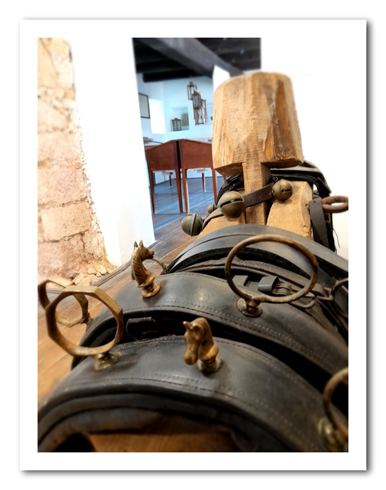
The belt manufacturers hung their wares at fairs on two branches dug into the ground – horizontally strengthened poles.
The last master belt maker in Gönc was János Gál Menyhért, who worked in his parents’ house from 1954. In the old days, it was customary for a father to buy a harness for his son before he got married. A harness made of good leather and by a good master could last for a generation, if the farmer took care of it, cared for it, and greased it so that it would not dry out. Its useful value is shown by the fact that between the two world wars, a good harness cost as much as a cow.
Exhibited items
▪ Copper fittings – works decorated with brass fittings, rings, buckles, and frills were more valuable due to their durable components and richness of detail.
▪ Saddlery – One of the most characteristic leather products related to animal husbandry. It helps to transfer the animal’s pulling power to the drawn structure, making it an indispensable accessory for agriculture and transportation. Most often, harnesses, saddles, bridles, and reins were made in the workshops, but clothing accessories such as trouser belts were also produced.
▪ Certificate for horse breeding, 1939. – Animal husbandry played a major role in Gönc, with significant cattle and horse breeding. The latter was boosted between the two world wars with awards, in addition to breed breeding, based on military needs.
Religious denominations
Around 1530, Gönc became Lutheran due to the Reformation. The first known Lutheran preacher was Sebastian Hauer. The schism that developed between the Protestant churches during Melanchthon’s time led to the spread of Calvinism. The first prominent representative of this in Gönc was the successor of István Székely Benczédi, Gáspár Károlyi.
The situation of the Protestant denominations became difficult in the second half of the 17th century due to the Counter-Reformation, and in 1695 the Jesuits prevented their free practice of religion.
In 1712, the Catholics took back their church, and after that the Gönc Reformed Church held its services in Göncruszká, Zsujtá and in the barns of various Protestant denomination members, such as the Szombathy family. At that time, the Catholic parish continued to register births.
In 1783, the decree of tolerance of Joseph II allowed the operation of Protestant denominations and allowed us to build churches. The church of the Reformed, which is still in use today, was consecrated in 1786.
During the 19th century, the number of Catholics in the settlement gradually increased, and in 1920 they already outnumbered the Reformed.
Given its commercial role, Gönc was a settlement inhabited by a significant Jewish community from the end of the 18th century to the middle of the 20th century. Their synagogue, which is no longer visible today, was built in the 1850s on the bank of the stream, opposite the later building of the small orphanage, which was demolished in the second half of the 1940s.
Views: 0