
The name of the first room of a country house, the first house or clean room, this room is the pride of the house, the property of a former peasant-citizen who grew grapes in Gönc. According to the customary law of the time, it always faced the street, and was used on holidays and when receiving guests.
Its cleanliness received special attention, as its tidiness greatly characterized the family, and its representative function reflected the family’s financial well-being. Its arrangement and furniture follow strict rules for each region. This ornate, tidy space is a symbol of cleanliness and solemnity in the village interior. It was primarily part of more affluent peasant houses, and its appearance in Hungary can be dated to the 18th century, and its spread in poorer regions, where it was possible to create only one living room, is not typical. A representative space, where the family’s cherished objects and most cherished memories were placed.
A holy corner was created in the clean room of the Hussite House, where the home altar and the carved crucifix with holy images are located. The special interior cannot be missing the high bed, which was only used for sleeping in exceptional cases, when a highly respected guest or a pregnant woman was laid in it. In many places, this bed also served as a coffin. The high shelving and covering of the dunnage is characteristic of the region.
In the authentic environment, the legends come to life, the photos of the people living in the house, their stories – wine trade, farming, bourgeoisization, marriage, dowry, gold rush – almost living history.
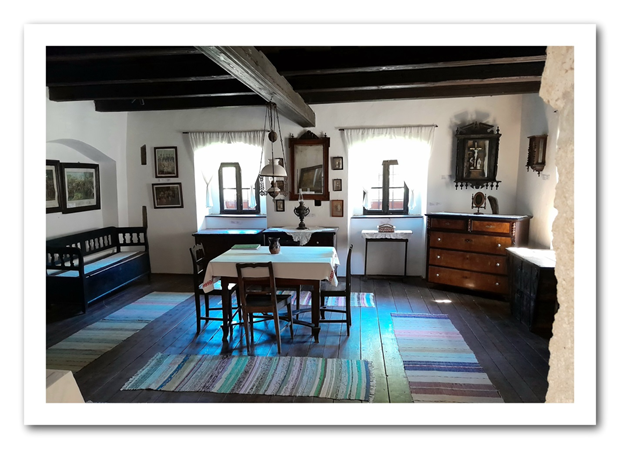
Furniture of the clean room
▪ Carved table, mid-19th century – A type of furniture of medieval origin, a so-called “chamber” (drawer) table made of hardwood, assembled without nails.
▪ Tiled stove, Hegyalja (Tállya) around 1820 – The characteristic and representative furnishing item of the living rooms of noble mansions and bourgeois houses of the 18th – 19th centuries was the stove decorated with mythological scenes.
▪ Oil prints, late 19th century – The holy pictures sold at fairs were the most common wall decorations of Catholic peasant and market town homes. The pictures were often framed with a veneer frame matching the exterior of the furniture.
▪ Single-door wardrobe, late 19th century – The wardrobe entered the living culture of the peasant and bourgeois in the market town as a piece of furniture of noble and bourgeois interiors. The turned pediment also recalls bourgeois furniture. In the peasant environment, clothes were kept in chests or on poles or hangers.
▪ Merchant’s chest, late 18th century – A chest reinforced with iron bars, decorated with wrought iron straps, in which merchants transported their carefully guarded goods to fairs and long-distance trade in the back of their carts.
▪ Wall clock, late 19th century – In the 19th century, the clock, previously unknown in the peasant material environment, appeared in the living rooms of market towns and in fashionable peasant homes. The wall clock with its turned ornamentation fits well with similar furniture.
▪ Chest of drawers, early 20th century – The peasant chest was replaced from the 18th century by the chest of drawers adopted from the noble-bourgeois housing culture, on the peasant-bourgeois version of which the veneer was imitated with painting. The chest is pushed into the pantry.
▪ Icon – chest, late 19th century – The wall chest that houses the small icons brought from indulgences, with its turned decorations and painting, looks to peasant furniture as a model. Thus, it is not only an important sacred object of the Catholic religion in the living room, but also a piece of furniture.
▪ Sewing table, early 20th century – A typical piece of furniture in noble and bourgeois interiors was a sewing table with drawers, serving and representing women’s work. From there, it was transferred to the bourgeois object environment of the market town.
▪ Álkomód/Ládakomód, early 19th century – A typical type of market town furniture, the ancient peasant chest was hidden with a front panel imitating a chest of drawers. Only the bottom drawer is real. Its painting imitates the grain of the veneer.
▪ Mirror, late 19th century – A veneered and turned, carved decorative mirror, an additional element of bourgeois furniture.
▪ Chest, early 19th century – The chest is the most common type of peasant furniture. The original floral painted chest had turned decorations reinforced and was later painted brown.
▪ Oil print, early 20th century – Emperor William and his family.
▪ Oil prints, late 19th century – The memory and cult of the 1848-49 civil revolution and war of independence were represented in the furnishings of Hungarian rural and field town living rooms by oil prints made by a duplicating process at the end of the 19th century and sold at fairs – “Get on your feet Hungarian”, “The thirteen martyrs of Arad”, “We give Lajos Kossuth at the session of the House of Representatives”.
▪ Bench/Armed chest, early 20th century – One of the most common seating furniture of peasant home culture. The seat can be opened and serves as a chest. Its armrest is turned, reminiscent of the decorative technique of bourgeois furniture.
▪ Dining cabinet, early 19th century – A two-part, typical piece of market town furniture made of softwood (pine), which was missing from the traditional peasant housing culture. It was used to store more ornate dishes and souvenirs for festive meals.
Views: 6