
Information flow
A permanent post office was established in Gönc in 1868, which made delivery and mailing more systematic. Göncruszka, Hejce, Telkibánya, Zsujta and Abaújvár were directly connected to the settlement in the postal network. A daily horse-drawn courier went to Hidasnémeti, which had a railway connection, and to Göncruszka.
In 1898, a telegraph was installed in Gönc, followed by a telephone in 1900. All this facilitated the revival of newspaper literature, through which information from the wider world and the country arrived, and local news could now also spread more quickly.
In 1869, a new type of mail was created, the open postcard without a picture, and from the end of the 19th century, the picture postcard, suitable for sending short texts and also delivered without an envelope, became popular. After the millennium, thousands of popular greeting cards were produced with street details and views of the country’s settlements. A series of such publications immortalizing Gönc also went into circulation.
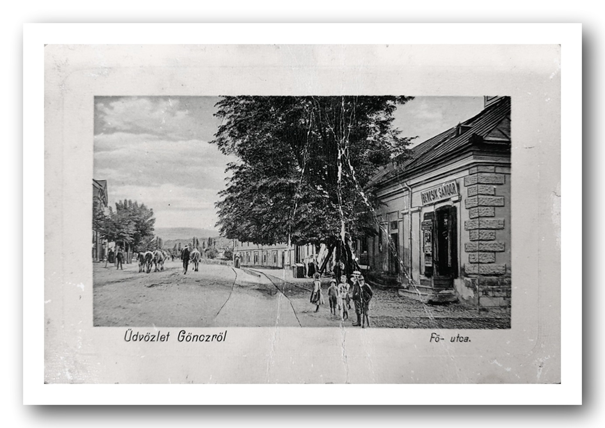
Göncz – Main Street
Image source: Local History and Ethnography Collection
Fire department
Fires were once a major problem in the life of settlements, often catastrophic. Roofing materials such as reeds, thatch, and shingles were all easily flammable, but due to their cheapness, they remained widespread until the middle of the 20th century. The wind could easily spread the fire to entire parts of settlements.
Fire protection in the 19th century was not yet effective, and the settlement administration tried unsuccessfully to restrict the use of flammable building materials with regulations. Professional firefighting tools, such as syringes, appeared in Gönc in the 1860s, and hooks, water-carrying vessels, and cups were also in use. The development of organized fire protection and the establishment of a volunteer firefighting association represented a major step forward.
The reality of the time is shown in the newspaper article entitled “Fires Everywhere” published in the Pesti Hírlap, issue 129, issue 17, published on May 12, 1895. In it, the Rev. János Füzy, pastor, writes about Gönc: “The destructive element struck at 9:30 a.m. at a poor house where bread was being baked. In just a few minutes – fanned by the hurricane-like wind – the sea of flames covered an entire part of the city! There was no question of rescue!”.
Exhibited objects
▪ Firefighter’s torch, early 20th century – Used for night work and parades.
▪ Firefighter’s helmet, early 20th century – The tools for fire protection were expanded from the 1860s with protective equipment, syringes, and water trucks.
▪ Group photo of the Gönc firefighters, first half of the 20th century – Firefighting equipment can be seen, in the background the water truck, ladders, the firefighters wearing helmets, carabiners, and signal horns.
Law enforcement
Due to its market town status that existed until 1871, the settlement independently organized law enforcement forces in order to deal with poor public safety conditions. Nighttime street order was maintained by night guards appointed from among the men of the population over the age of 18 from 1860, and their leader was the city police captain.
Before the establishment of the gendarmerie, a professional policeman, or pandur, also served, and the city jail was guarded by a tolonc. After the establishment of the gendarmerie in 1881, a gendarmerie patrol affected Gönc, and then a gendarmerie station also operated periodically with a section.
The civil guard was officially established in 1887, and was led and controlled by the civil guard board.
Exhibited objects
▪ Service book of Lajos Bazsó, a policeman from Abaújszántó, 1882. – His service time, the location of his patrols, and the time of his homecoming were recorded in it. He served on day and evening patrols in Gönc, Boldogkőváraljá, Hernádbűd, Gibárt, Boldogkőújfalu, and Felsődobsza.
▪ Key to the men’s prison
Military service
Gönc was a conscription district center, where conscripts from surrounding settlements gathered. Conscription took place by recruitment or by forced capture.
On April 21, 1848 – following revolutionary aspirations – the Gönc National Guard was founded, and then the Gönc people fought in the 9th Home Guard Battalion. In February 1849, fighting took place at Gönc Liget and Hidasnémeti.
In the 1860s, imperial troops were stationed in the settlement as a law enforcement force. In 1868, the Home Guard was established alongside the Imperial and Royal Joint Army.
Military conscription and the conscription of certain age groups were part of the life of the counties. Gönc, the VI. Corps, including the 34th Infantry Regiment.
A memorial, a memorial park and a place of remembrance pay tribute to the victims of the First and Second World Wars.
Exhibited objects
▪ German-language soldier’s book of the Imperial and Royal Joint Army, 1870s – With the data of the person called up, with a Hungarian-language appendix.
▪ Military chest from 1915, for the personal belongings of the draftee – Such chests were used from the end of the 19th century to 1945, with the obligatory green paint between the two world wars. They were often made by the draftee himself.
▪ Postcards sent to Gönci from a Soviet prisoner of war camp, 1947.
Celebrations
The life of the settlement was enlivened from time to time by festive occasions. In addition to their power to shape the local community, Gönc was connected to national cults and representative events through them, so the celebrations had a larger-scale, national self-consciousness-forming role during the 19th and 20th centuries.
The major celebrations included flag parades, bonfires, bell ringing, decorated houses, festive lunches, speeches, and performances.
The Gönc Horse Bandery / The Gönc Horse Bandery
The group, consisting of young men, wore loose-fitting linen trousers, black cloth coats decorated with a row of brass buttons, and small-brimmed hats. From the second half of the 19th century, they organized their own events, such as charity balls, the proceeds of which were used to help the poor.
Exhibited objects
▪ Horsemanship Bandérium cloth coat with copper butterfly buttons, late 19th century – early 20th century
▪ The flag of the Gönc Horsemanship Bandérium – The horsemanship bandérium was a representative body of adult men, providing a ceremonial escort during celebrations. The flag was last used in 1948, during the greeting of József Mindszenty.
▪ Flag ribbon, 1901. – The flat-embroidered design depicts the coat of arms of the market town of Gönc. The flags played an important role during the town’s festivals, and in processions they served as representatives of individual groups, such as industrial associations. The industrial association flags were made based on guild traditions.
Infrastructure
Gönc’s reconstructable 19th-century appearance, a kind of imprint of the settlement’s carefully guarded market town status that existed throughout the Middle Ages, was characterized by both urban and rural features.
After the termination of the market town status in 1871, the village preserved much of its former autonomy, which was primarily manifested in the organization and implementation of infrastructural activities.
The paving of roads was not widespread, only the sidewalks were made of stone, even the most important roads were only strewn with gravel, and maintenance was led by a roadmaster from the 1860s.
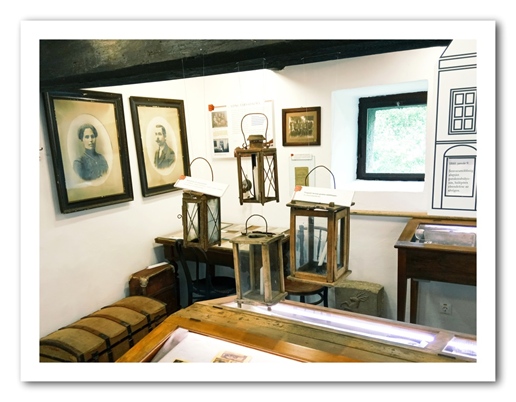
Public lighting was a long-neglected modernization achievement; in 1898, for example, only four street lamps lit in front of the town hall; electricity supply began in 1933 from the Gibárti Electric Works.
During the 19th century, the population used wax candle lamps for lighting, and then, as a manufactured product, the kerosene lamp remained widespread in households until the 1950s.
Exhibited objects
▪ Road tax record, 1892. – Half of the road tax could be paid in exchange for work. The classification, maintenance and upkeep of roads was regulated by Act I of 1890.
The railway
A significant development in the modern history of Hungary was the development of the railway network. By August 1860, the Pest – Miskolc – Košice railway line was built, and a starting house was established about three quarters of an hour’s journey from Gönc.
With the financial contribution of the surrounding settlements, the Szerencs – Hidasnémeti, a local railway line also affecting Gönc, was built by September 1909. The reason for its construction was, in addition to the passenger and freight traffic demand, the high demand for raw materials for the Szerencs sugar factory, which had been operating since 1889, and the loss of trade due to the destroyed grapevines due to phylloxera, which was tried to be compensated for by stimulating the railway traffic in Hegyalja.
Exhibited objects
▪ Bacter lamp, first half of the 20th century – A signaling and lighting device for shunting, track inspections, and other nighttime railway work.
▪ Glazed, slatted frame, candle-lit stable lamp, second half of the 19th century.
Education
It is thanks to the Calvinist trend of the Reformation that in the 16th century, high-quality secondary education was provided, the impact of which far exceeded the borders of the settlement. Education was tied to the churches for a long time, which was also reflected in the curriculum.
From 1712 to 1784, only a Catholic school operated, and the education of the reviving Reformed Church had a primarily local role. The building of the Gönc Reformed School was later located in the building of the present-day Károlyi Gáspár Bible Museum, which was also supported by Antal Csáky, the Lord of Szepes.
The Catholic school received a new building at the beginning of the 19th century instead of the old one destroyed by fire. Elementary education was provided, which consisted of learning writing, reading, arithmetic, church songs, and texts. It proved to be a persistent problem that the labor of the children of those who lived from agriculture was needed during the field and arable work, so they could not study for a significant part of the year and had to work.
As a result of the educational reform of József Eötvös, a qualitative improvement began in public education, the curriculum was expanded with knowledge of natural science, history, geography, physical education, and civil law, teaching materials increased, and educational conditions improved.
In Gönc, a kindergarten opened in 1895. Between the two world wars, the number of schoolchildren increased, and the curriculum was further expanded.
Exhibited objects
▪ Certificate of recognition from a Gönc teacher trained in Miskolc, 1853.
▪ School textbook – János Arany: Buda halála volume from the end of the 19th century
▪ Natural history textbook published in 1889
▪ Abacus, first half of the 20th century – Educational tool for children to learn to count
▪ Slate writing board, first half of the 20th century – Its use in education became widespread after its spread in the early 19th century, and in some places it remained after 1945. It was pushed into the background with the decrease in the price of paper.
Gönc society / The society of Gönc
A characteristic of the social structure of Gönc was the large number of industrialists and nobles. Industry played an important but not dominant role, the decisive form of livelihood was arable farming and animal husbandry, which was supplemented by viticulture, horticulture and forestry. The craftsmen were engaged in agriculture and wine production in addition to their industry.
Only one percent of the population of the Hernád Valley were large and medium-sized landowners, ten percent were middle peasants, while the proportion of agricultural workers and servants was eighty percent. In the last third of the 19th century, merchants and industrialists were present in a higher proportion in Gönc society than in the surrounding settlements, which indicates the modest degree of bourgeoisification o
Views: 0