
Pottery
Pottery is a folk craft, which was initially practiced by the serf craftsmen of the feudal estates, and later primarily by the craftsmen who were grouped in urban and market town guilds and engaged exclusively in industrial and commercial activities.
From the beginning of the 16th century, potters were active in the settlement in smaller and larger numbers, as can be proven by written records. Gönc pottery experienced a brief, lively boom in the second half of the 19th century, given the weakening of the Miskolc and Košice pottery guilds. At that time, many potters left the peasantry, as it was difficult to make a living from farming.
The main profile of the profession in Gönc is the making of milk pots, as the local name csupros refers to. The primary consideration was function, not decoration, which was the basis for the reputation and market of pottery products. The simplest motif was the galáris drawn on the neck of the vessel with a kaolin brush. A smaller part of the milk pots were decorated with flowers, but decoration was also made by scratching and carving. The types of vessels produced in Gönc were szilkék, mugs, small cups, bowls, tarkedli ovens, buckets, pots, bricks, and tile bases.
Clay suitable for making vessels could be mined in several places on the borders of Gönc. Each of the Gönc potters produced the clay himself with family help, and did not have to pay for it, because each potter family bought a few square areas on the border with good clay.
Master potter Lajos Veres once obtained it from their land at the bottom of the “Nyetrebák” and from the “Kavacsos” area, transported by cart, tractor, and truck. The Gönc csupros sold the vast majority of their products to merchants, and a smaller part of them they sold themselves, either from their homes or at markets. The Gönc product was known and sought after, from Košice to Nyíregyháza, because – as the local saying goes – “the milk gave up the fettuccine better in that”.
The reason for the decline of the craft was actually the cessation of backyard cattle farming and the emergence of mass production.
Exhibited objects
▪ Hard earthenware vessel, early 20th century – Hard earthenware factories decorated their vessels based on a pattern used nationwide.
▪ Butykos jug, around 1900 – A pálinka storage vessel, its name comes from the bubbling sound of the drink flowing out of the narrow neck. Typically green glazed, with scratched decoration.
▪ Pottery jug, 1930s – Brown or black glazed pottery, the glaze recipe of which was carefully guarded by the masters.
Hemp work – weaving – spinning
The cultivation and processing of hemp has a history that goes back several centuries in Hungarian peasant farms. The spinning of fine hemp and flax fibers into yarn, then weaving it into linen and textiles, and the production of binding materials played a significant role in households.
In Gönc, lands were used for hemp cultivation on the outskirts of the village and near the stream. In the second half of the 19th century, hemp plantations stretched on the lands behind the Reformed church and behind the Melegvíz row. The processed plant provided the family’s yarn, rope and textile needs, both in the home and on the farm. Textiles made by cottage industry for everyday use are tablecloths, scarves and bags. Typically, hemp work was women’s work, one of the community occasions of the winter season.
The process of hemp utilization consists of preparation, spinning, weaving. Preparation is represented by the work processes of stretching, soaking, drying, banning, and carding. This traditional practice in Gönc looked like this until the 1950s: Soaking the hemp was the first task, the hemp stalks were soaked in a compartment formed with stakes in the Gönc stream, in stagnant water drained from the stream or in separate pits.
Soaking pits were once lined up at the railway station. During the soaking, the inner, woody part of the hemp stalk rotted. After drying, the break with the banning machine followed. A large-scale water-powered pulverizer broke the hemp, which was also used in Gönc.
After breaking, the husk, the crushed woody part of the fibers of the stems, was removed. This was followed by softening the stiff fibers with a wooden hammer called a kótis, and finally the fibers were combed out by carding in order to make the raw material suitable for spinning.
The spinning process consists of twisting and winding into yarn. Weaving takes place on a loom as a complex work process, which requires the warp yarn to be raised vertically and the weft yarn to be tied horizontally.
Exhibited objects
▪ Tamoló – A tool for breaking and cleaning the inside of the hemp stalk, a single-arm lift.
▪ Gereben – A wooden tool for combing wool fibers and fibers.
▪ Spool – A device that holds the fiber bundle during spinning.
▪ Spindle – A device that spins fibers into yarn with a foot pedal, which also winds the finished yarn onto a bobbin.
▪ Spindle, spinning wheel – A spinning device for spinning and winding fiber or wool fibers.
▪ Winder – A device for weighing and sorting the finished yarn.
▪ Loom – Fabric, linen
Wool processing
Wool has been a valuable raw material for thousands of years. Even during sheep farming, care was taken to ensure its integrity, its preparation began with shearing and washing, followed by tearing and combing with a comb.
After soaking and drying, the wool could be dyed, many plants are suitable for coloring, for example, walnut leaves and sedges give green and brown, meadow plants such as elderberry and snowberry produce a bluish gray, and lamb’s rue and blackthorn produce a red color.
The spinning of wool, the preparation of the raw material for weaving, began either dyed or left raw. The ancient hand-spun tool for spinning is the spindle, which is a wooden stick with a wooden disc on it to help the momentum. The woolen knot was tied to a loom, and a decorated, two-legged version was widespread in the Highlands, which was made by young men and given to young women as a love gift.
The more complex tool of weaving, the spinning wheel, is also called a spinning wheel in the region. The loom served to weave woolen yarns into textiles, from coarser sackcloth to finer cloth.
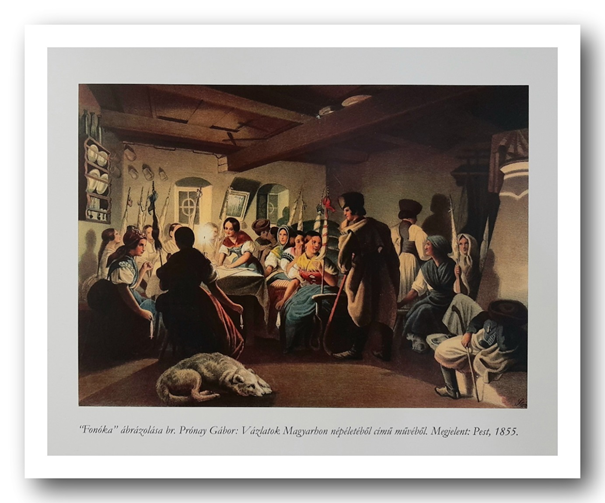
The cloth was made by szűrsazábók (spun-weavers), and the looms enriched with woolen tufts were made by the gubacsapók (spun-weavers), a guild of Gönc founded in 1835. Woolen work done in a community in a kaláka (spun-weaver) was called spoñó (spun-weaver), or guzsalyas (spun-weaver), where singing, giving gifts and, last but not least, getting to know the young men who came to visit took place during the work.
Folk washing traditions
The methods of cleaning linen vary from region to region, but the essence of the process, regardless of geographical area, is that the alkaline dissolution of the dirt is followed by the removal of the lye with plenty of clean water – mainly by beating.
The first phase of washing is placing the wet laundry in a tub or washing basin. A coarsely woven canvas was spread on top, onto which wood ash was sprinkled. Hot water was poured on the ash, which melted through the textile and the lye permeated the clothes. The alkaline water was heated again and poured on the ash again. This process was repeated several times, and then, preferably in a stream of clean water, it was beaten with wash weights placed on a washboard. The impact and the flow of water released lye from the textiles.
The lye used for centuries was replaced by laundry soap. Washcloths, engraved and decorated with geometric or plant motifs, often served as wedding gifts. Men gave them to young wives, and they were often made by professional craftsmen or shepherds.
Washing was associated with many beliefs and prohibitions in folk memory. It was forbidden to wash on Fridays, Sundays and on church holidays. The most typical days of prohibition were the days of Luca and Borbála, on which, in Gönc, a fair was also held. On these days, it was forbidden to sew, wash, or do any kind of women’s work.
According to a belief spread throughout the country – including in Gönc – lightning would strike the people who had finished their laundry until someone admitted that they had cleaned clothes on Friday.
Exhibited objects
▪ Wringer – A tool for washing and rubbing clothes, its name refers to German origins, derived from the term reiben.
▪ Wash weights – A rectangular, downward-widening, often richly decorated, carved hardwood tool, used to beat the leached linen, which was used in stream or lake water to wring out clothes laid on a washstand.
▪ Ironer – A tool used for smoothing after washing, for which the linen was rolled onto a stretcher and rolled with the ribbed side of the ironer.
Views: 2