
THE HUSSITE TRADITION
According to stories passed down in Gönc over the last century, the Gönc Hussite House was built and inhabited in the mid-15th century by Hussite warriors who settled in the town after the Hussite Wars and gradually assimilated into the local population. According to a legend preserved for centuries in the former market town, the house was owned by the mercenary leader Johann Giskra, whose raiding and plundering troops were stationed locally, in the ancient eastern part of the settlement. In the vicinity of the headquarters, so-called Hussite-style houses were built, from which—connected to their military activities—the surrounding area was kept under control.
Historical research, however, does not confirm this folk tradition. There is no clear evidence that the building type preserves the architectural traditions of the Hussites who conquered the Highlands, nor that it served defensive purposes. As a result, the origin of the building remains disputed. The recorded tradition most likely dates back to the early period of Protestantism, as during the era of re-Catholicization the term Hussite was often used as a pejorative label to hinder church occupations. Since Gönc was once a predominantly Protestant settlement, the name Hussite may have survived in public memory.
Although historical sources are incomplete and data from contemporary censuses do not necessarily support the folk tradition, the people of Gönc—based on their own beliefs—remain convinced of the former presence of the Hussites. To this day, houses with basements are still referred to as Hussite houses. According to local legend, a system of interconnected tunnels runs beneath the houses, allegedly leading all the way to Košice. In reality, stone-walled residential buildings of fortress-like appearance can still be found in the central part of Gönc.
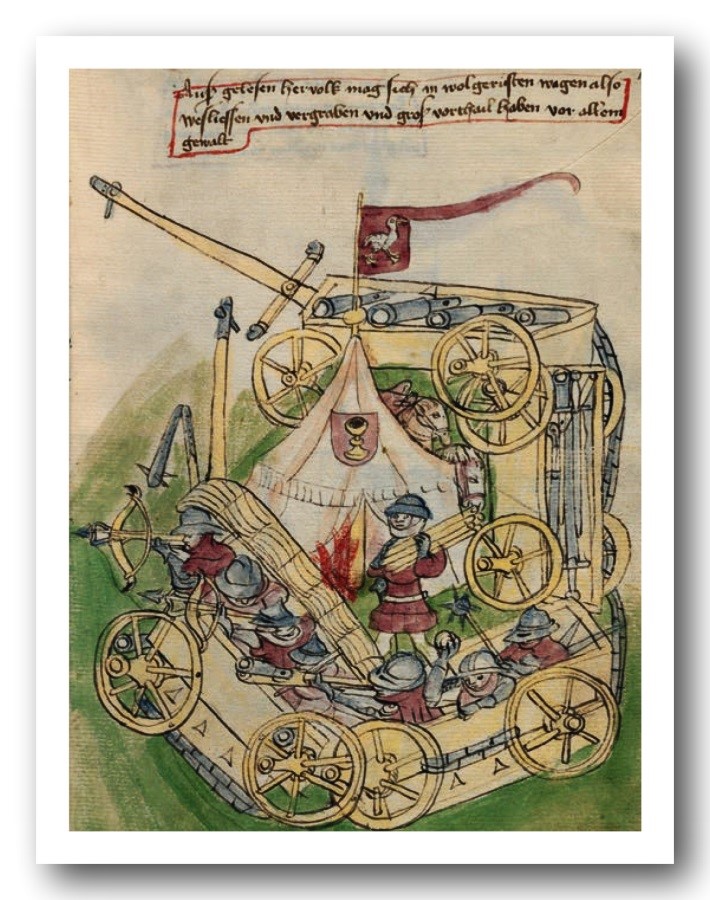
Hussite chariot castle – miniature 15th century Image source: Chronicle of the Hungarians – Officina Nova 1995.
The 15th-century Hussite legend is closely connected to the Gönc region through the figure of Johann Giskra von Brandeis (c. 1400–1469), a mercenary leader of Moravian origin. For several years, due to his military activities, he was the lord of the mining towns in the Highlands and served as captain-general of the city of Košice. At that time, the Gönc area belonged first to the Bebek family of Vámos, then to the Szapolyai family, and from 1497 to the Spiš Chapter.
The name of the neighboring eastern part of Hejce, known in popular tradition as “Bohemia” for several centuries, also suggests an interesting etymological origin, as buildings reminiscent of the Gönc Hussite House can be found there as well. It is also a fact that in this county, folk tradition still refers to old or ruined churches as “Czech churches”, further reinforcing their perceived age and antiquity.
The central figure of the Hussite tradition around Gönc is Johann Giskra, who began his military career in Italy, where he acquired outstanding tactical knowledge. During the reign of King Sigismund (1387–1437), he came to Hungary, later fought against the Hunyadi family, and eventually entered the service of King Matthias (1458–1490), their agreement being based on a marriage alliance. The harsh fighting style characteristic of the Hussites is closely associated with his name.
According to contemporary chronicles, the well-established Hussite strategy relied on the seizure of fortress-like castles in the Highlands, which provided a secure base and made enemy attacks easier to repel, thereby enabling control over relatively large territories. As a result of their military campaigns, the Hussites amassed significant financial resources: in addition to income from mercenary service, they levied taxes and tribute from local peasants, while peaceful Czech and Moravian craftsmen were granted settlement rights in the vicinity of the castles. Giskra’s military success was largely based on the combined use of defensive tactics and the wagon fort, which encapsulated the essential elements of Hussite warfare.
The Hussite Fighting Style
The offensive–defensive tactic was already known in ancient Celtic times, and similar methods resulted in considerable military success and substantial spoils of war. The use of the war wagon in combat was, in fact, an old-new weapon. On the one hand, it served as a means of troop transport; on the other, the forward battery positions provided significant firepower.
The Hussite war wagon combined the functions of a firearm platform and a supply wagon. The wagons were linked together with chains; archers and spearmen were positioned on the wagon platforms, while the protected personnel were placed in the center of the wagon fort. The structure could be moved in columns using draft animals. Given the military technology of the period, this method of combat was virtually unbeatable and led to rapid success.
Views: 13