
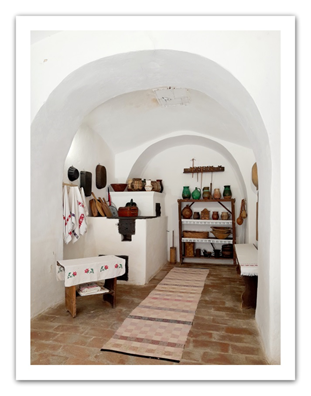
Atrium – open-chimney kitchen
The atrium or kitchen is located between the clean room and the back house. The family spent most of their life in the open-chimney kitchen and the back house, according to tradition. The kitchen of a country house provides a higher level of comfort compared to smoky kitchens, as we can speak of an effective smoke exhaust system. An open chimney is usually an open smoke exhaust structure built into the ceiling of the kitchen, leading to the outside. In the case of a smoky kitchen, when the air space of the kitchen was filled with smoke, the doors and windows were opened, as a result of which the heat also left the room, especially in winter. In 17th-century Hungary, open chimneys usually covered the entire back part of the kitchen from wall to wall, and this solution was used with preference in the market towns of the time due to its simplicity. Thanks to modernization, more and more open chimneys with vaulted smoke and spark arresters made of brick or stone elements were built throughout the country, and this is practically the case in our country houses. In the kitchen, you can see the stacked sparhelt built of Gönc bricks – a fireplace with open smoke exhaust – the advantage of which was that it solved heating, baking, cooking and lighting at the same time. The history of the clay mined in the “Brick Color” area – as a raw material and building material – is now just a rumor. The layout of the atrium reveals that this room typically housed movable furniture – a water bench, a shelf on legs – for practical reasons. You can see the “Rosemary-Rooted Green-Glazed Etched Gönc Pitcher”, and the characteristic unglazed “May Inscription Milk Jug”, which are valuable and classic pieces of Gönc pottery. Their value at the time is shown by the fact that they served as distinguished personalized gifts. Often made by craftsmen on a personal basis, the green-glazed piece exhibited in the country house was made in 1928 for Mrs. Szombati Józsefné. The history of wooden kitchen utensils – a knife, a cucumber slicer, a small ladle, a wooden strainer – is that all of the tools are made by local craftsmen. It is worth highlighting the so-called habaró wood, which has an outstanding ethnographic value typical of the region. The wine bottles on display come from the Zemplén huts, and the hard earthenware and porcelain dishes were brought to the exhibition space from nearby Telkibánya and Hollóháza.
Views: 1